
Disinformation as information integrity
Mapping NGO capture of permissible narratives at the United Nations


By many accounts, the 30th meeting of the UNFCCC Conference of the Parties (COP30) in Brazil was over before it started. One of the things to make its way out of the gathering was the Declaration on Information Integrity on Climate Change hosted by UNESCO and was signed by a handful of countries.1
The Declaration received a nod on social media with many mentioning it sent a chilling message. But for the most part it too passed without much attention.
The Declaration deserves a fair showing though for what it represents in the next stage of narrative control in climate change science and advocacy.
If it is true that the world has moved on from climate change- and I think that it is true- then the relentless push for discourse power (to borrow a hotly discussed term from the CCP) is relevant for global affairs.
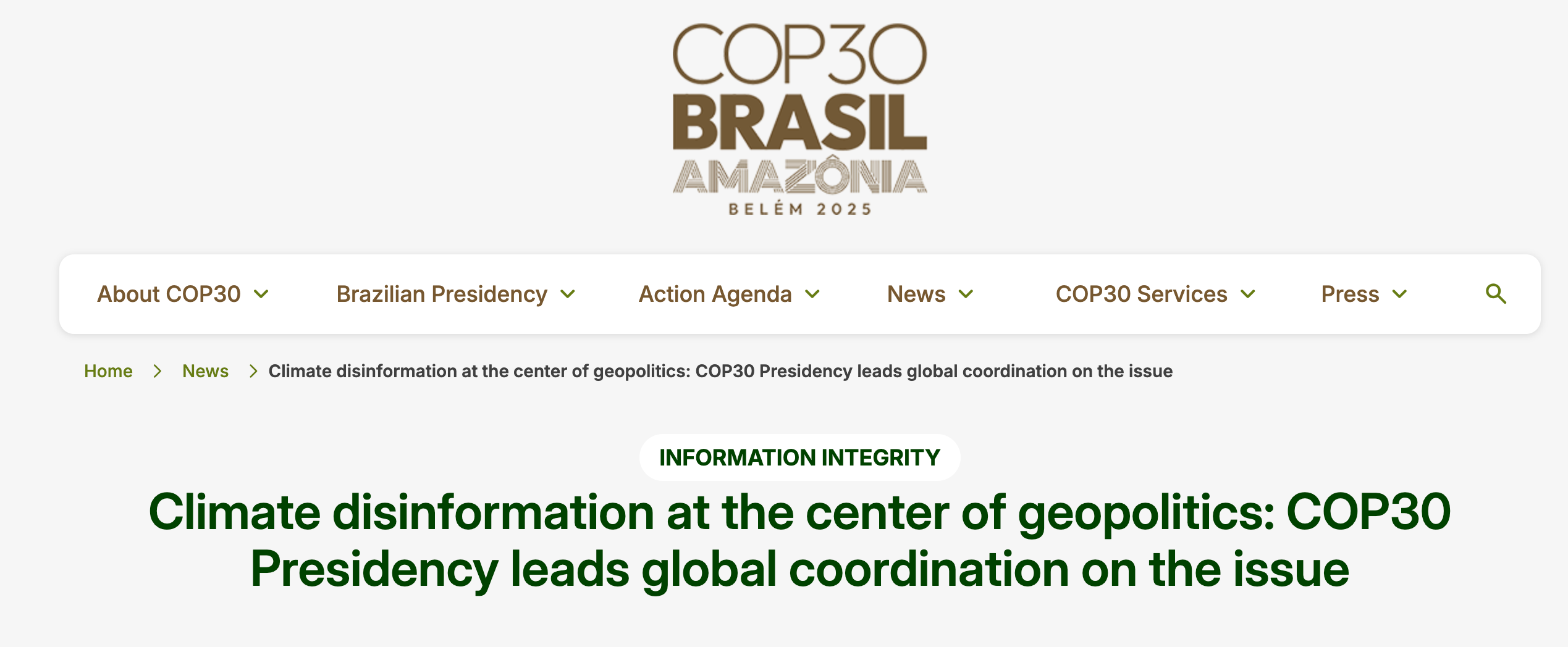
In fact, COP 30 marketed the focus on disinifrmaton specifically in relation to geopolitics (below). Head of the Climate-KIC, Europe’s largest public-private partnership focused on climate innovation, cites the need for “cognitive security” to confront climate change. Meanwhile, the UN has teamed up with a co-founder of Avaaz to create a global network of youngish Tik-tok influencers to “persuade”, “reach target audiences en masse”, and “encourage global cooperation.”
It’s all weird stuff.
The Declaration is inspired by those,
Concerned by the growing impact of disinformation, misinformation, denialism, deliberate attacks on environmental journalists, defenders, scientists, researchers and other public voices and other tactics used to undermine the integrity of information on climate change, which diminish public understanding, delay urgent action, and threaten the global climate response and societal stability;
The Declaration calls on the private sector and governments to establish policies to promote “information integrity” on climate change.
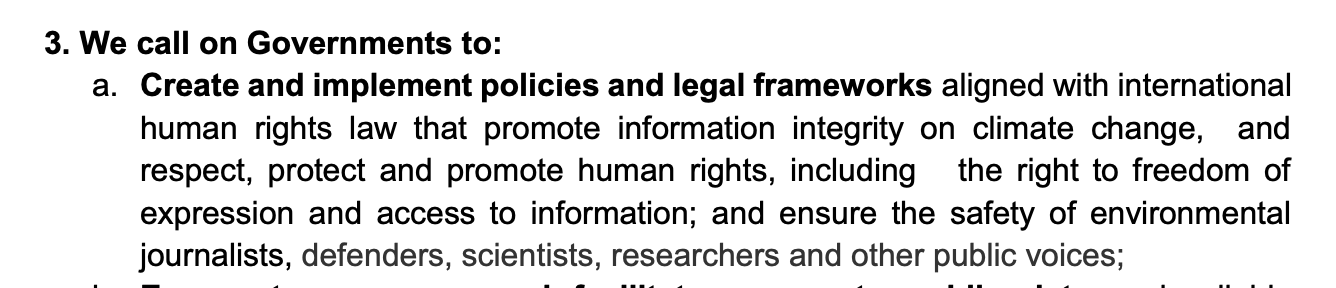
Let’s be very clear that no matter how well intentioned this may be it is an overt effort to control the permissible narrative around climate change especially as it pertains to policymaking and the courts.
The Declaration is underpinned by the UN Global Principles of Information Integrity and the Declaration was organized by the Global Initiative for Information Integrity on Climate Change, a project of Brazil, the UN, and UNESCO.
Let’s take these in parts.
The Principles of Information Integrity were developed by the UN Department of Global Communications.
The Principles describe information integrity as follows:
Information integrity entails a pluralistic information space that champions human rights, peaceful societies and a sustainable future.
Authors of the Principles intend they be used as the foundation to launch coordinated efforts around shaping information:
Harness the Global Principles to form and actively participate in broad cross-sector coalitions on information integrity, convening diverse expertise and approaches, including for capacity-building, from civil society, academia, media, government and the international private sector, and ensuring full and meaningful youth engagement, such as through dedicated youth advisory groups.
The result is that the experts and preferences of those chosen to lead these coalitions on information integrity become the rulers of strategic global narratives.
In its first Issue Brief on information integrity, the Department of Global Communications points to the Global Initiative for Information Integrity on Climate Change (GIIICC) as exemplar use of the Principles.
The GIIICC is a project of Brazil, UNESCO, and the UN aimed at
investigating, exposing, and dismantling disinformation related to climate change, as well as the socialization of the results of the research
The GIIICC is advised by
Climate Action Against Disinformation
International Panel on Information Environment
Conscious Advertising Network
I4T Knowledge Global Network
Forum on Information and Democracy, and
World Meteorological Organization
All of these have some interesting things about them but here and in the next post I will look a bit more at the first two, CAAD and IPIE.
The CAAD website acknowledges only a few organizations (shown below) said to be part of its 90 members.
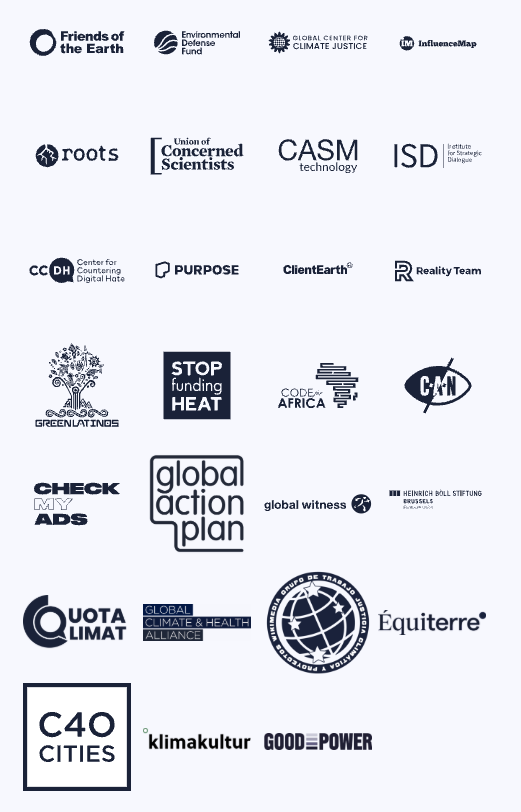
CAAD’s work centers on a narrative about the fossil fuel industry campaign to “Deny, Deceive, Delay” thereby “obstructing” transformative climate action. For CAAD, disinformation means This is an overly simplistic telling of the past 30+ years of international engagement over the topic of climate change and energy. As such, it is its own disinformation campaign: it fails to take seriously the history and practical technicalities of suppling energy to societies, and the origination of the delay narrative with intention of pursuing litigation- of which several of the groups pictured above are involved.
CAAD would be old news except, the same messages from the same players. Except that work is now a key part of the in the United Nations’ global communication efforts on information integrity.
Let’s not forget the small army of Tik-Tok influencers the UN has organized together with an Australian political activist to “Verify” correct climate narratives.
CAAD’s methodologies is therefore of interest. We’ll take a look at this and IPIE in the next post.
Brazil, Canada, Chile, Denmark, Finland, France, Germany, Spain, Sweden, Uruguay
On a bright note, our new ambassador to the UN, Mike Waltz, sees through a lot of this and refuses to have the US engage. He just did a great interview on Shawn Ryan and explained the inner workings of the UN. He also mentioned the US is withholding our payment (25% of their budget) to the UN until some structural changes are made.
Trump just pulled the US out of 66 organizations to include several within the UN tonight via an EO this evening. Climate change related of course. I knew it would be rough but not even one year....
Here is the list from the EO:
Presidential Actions
Withdrawing the United States from International Organizations, Conventions, and Treaties that Are Contrary to the Interests of the United States
Presidential Memoranda
January 7, 2026
MEMORANDUM FOR THE HEADS OF EXECUTIVE DEPARTMENTS AND AGENCIES
By the authority vested in me as President by the Constitution and the laws of the United States of America, I hereby direct:
Section 1. Purpose. (a) On February 4, 2025, I issued Executive Order 14199 (Withdrawing the United States from and Ending Funding to Certain United Nations Organizations and Reviewing United States Support to All International Organizations). That Executive Order directed the Secretary of State, in consultation with the United States Representative to the United Nations, to conduct a review of all international intergovernmental organizations of which the United States is a member and provides any type of funding or other support, and all conventions and treaties to which the United States is a party, to determine which organizations, conventions, and treaties are contrary to the interests of the United States. The Secretary of State has reported his findings as required by Executive Order 14199.
(b) I have considered the Secretary of State’s report and, after deliberating with my Cabinet, have determined that it is contrary to the interests of the United States to remain a member of, participate in, or otherwise provide support to the organizations listed in section 2 of this memorandum.
(c) Consistent with Executive Order 14199 and pursuant to the authority vested in me as President by the Constitution and the laws of the United States of America, I hereby direct all executive departments and agencies (agencies) to take immediate steps to effectuate the withdrawal of the United States from the organizations listed in section 2 of this memorandum as soon as possible. For United Nations entities, withdrawal means ceasing participation in or funding to those entities to the extent permitted by law.
(d) My review of further findings of the Secretary of State remains ongoing.
Sec. 2. Organizations from Which the United States Shall Withdraw. (a) Non-United Nations Organizations:
(i) 24/7 Carbon-Free Energy Compact;
(ii) Colombo Plan Council;
(iii) Commission for Environmental Cooperation;
(iv) Education Cannot Wait;
(v) European Centre of Excellence for Countering
Hybrid Threats;
(vi) Forum of European National Highway Research Laboratories;
(vii) Freedom Online Coalition;
(viii) Global Community Engagement and Resilience Fund;
(ix) Global Counterterrorism Forum;
(x) Global Forum on Cyber Expertise;
(xi) Global Forum on Migration and Development;
(xii) Inter-American Institute for Global Change Research;
(xiii) Intergovernmental Forum on Mining, Minerals, Metals, and Sustainable Development;
(xiv) Intergovernmental Panel on Climate Change;
(xv) Intergovernmental Science-Policy Platform on Biodiversity and Ecosystem Services;
(xvi) International Centre for the Study of the Preservation and Restoration of Cultural Property;
(xvii) International Cotton Advisory Committee;
(xviii) International Development Law Organization;
(xix) International Energy Forum;
(xx) International Federation of Arts Councils and Culture Agencies;
(xxi) International Institute for Democracy and Electoral Assistance;
(xxii) International Institute for Justice and the Rule of Law;
(xxiii) International Lead and Zinc Study Group;
(xxiv) International Renewable Energy Agency;
(xxv) International Solar Alliance;
(xxvi) International Tropical Timber Organization;
(xxvii) International Union for Conservation of Nature;
(xxviii) Pan American Institute of Geography and History;
(xxix) Partnership for Atlantic Cooperation;
(xxx) Regional Cooperation Agreement on Combatting Piracy and Armed Robbery against Ships in Asia;
(xxxi) Regional Cooperation Council;
(xxxii) Renewable Energy Policy Network for the 21st Century;
(xxxiii) Science and Technology Center in Ukraine;
(xxxiv) Secretariat of the Pacific Regional Environment Programme; and
(xxxv) Venice Commission of the Council of Europe.
(b) United Nations (UN) Organizations:
(i) Department of Economic and Social Affairs;
(ii) UN Economic and Social Council (ECOSOC) — Economic Commission for Africa;
(iii) ECOSOC — Economic Commission for Latin America and the Caribbean;
(iv) ECOSOC — Economic and Social Commission for Asia and the Pacific;
(v) ECOSOC — Economic and Social Commission for Western Asia;
(vi) International Law Commission;
(vii) International Residual Mechanism for Criminal Tribunals;
(viii) International Trade Centre;
(ix) Office of the Special Adviser on Africa;
(x) Office of the Special Representative of the Secretary General for Children in Armed Conflict;
(xi) Office of the Special Representative of the Secretary-General on Sexual Violence in Conflict;
(xii) Office of the Special Representative of the Secretary-General on Violence Against Children;
(xiii) Peacebuilding Commission;
(xiv) Peacebuilding Fund;
(xv) Permanent Forum on People of African Descent;
(xvi) UN Alliance of Civilizations;
(xvii) UN Collaborative Programme on Reducing Emissions from Deforestation and Forest Degradation in Developing Countries;
(xviii) UN Conference on Trade and Development;
(xix) UN Democracy Fund;
(xx) UN Energy;
(xxi) UN Entity for Gender Equality and the Empowerment of Women;
(xxii) UN Framework Convention on Climate Change;
(xxiii) UN Human Settlements Programme;
(xxiv) UN Institute for Training and Research;
(xxv) UN Oceans;
(xxvi) UN Population Fund;
(xxvii) UN Register of Conventional Arms;
(xxviii) UN System Chief Executives Board for Coordination;
(xxix) UN System Staff College;
(xxx) UN Water; and
(xxxi) UN University.