

The Stern Review is 20 years old this month. At its height, it was the go-to justification for a sweeping effort to remake banking and investment around promptly ending fossil fuel use. Its legacy runs through today’s fights over finance and industry.
Much of this ordeal appears to be reaching an end point of sorts: arguments in front of SCOTUS for Suncor v Boulder County, legislators’ concerns about California’s ties to China, climate antitrust allegations, and sharp drop in tolerance for a climate agenda. Even still, a global network of money and ideology decades in the making still exists.
Critiques of the Stern Review were serious. Relevant for this post is an early critique from Richard Tol and Gary Yohe that the Review underestimated the cost of climate change policy by
omitting the economic repercussions of dearer energy, and ignoring the capital invested in the energy sector.
Here, we’ll take a look at a small slice of what the snowball that started rolling 20 years ago, looks like today.
This post is the second in the series, Did China Capture California? The first is below.

California & the United Kingdom
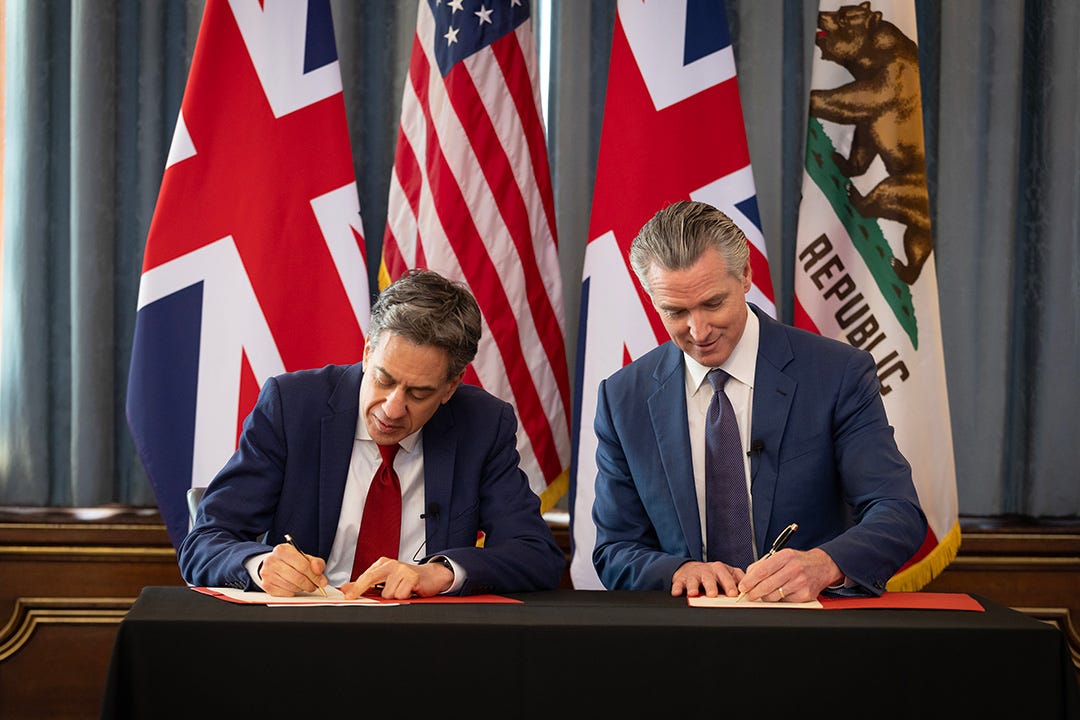
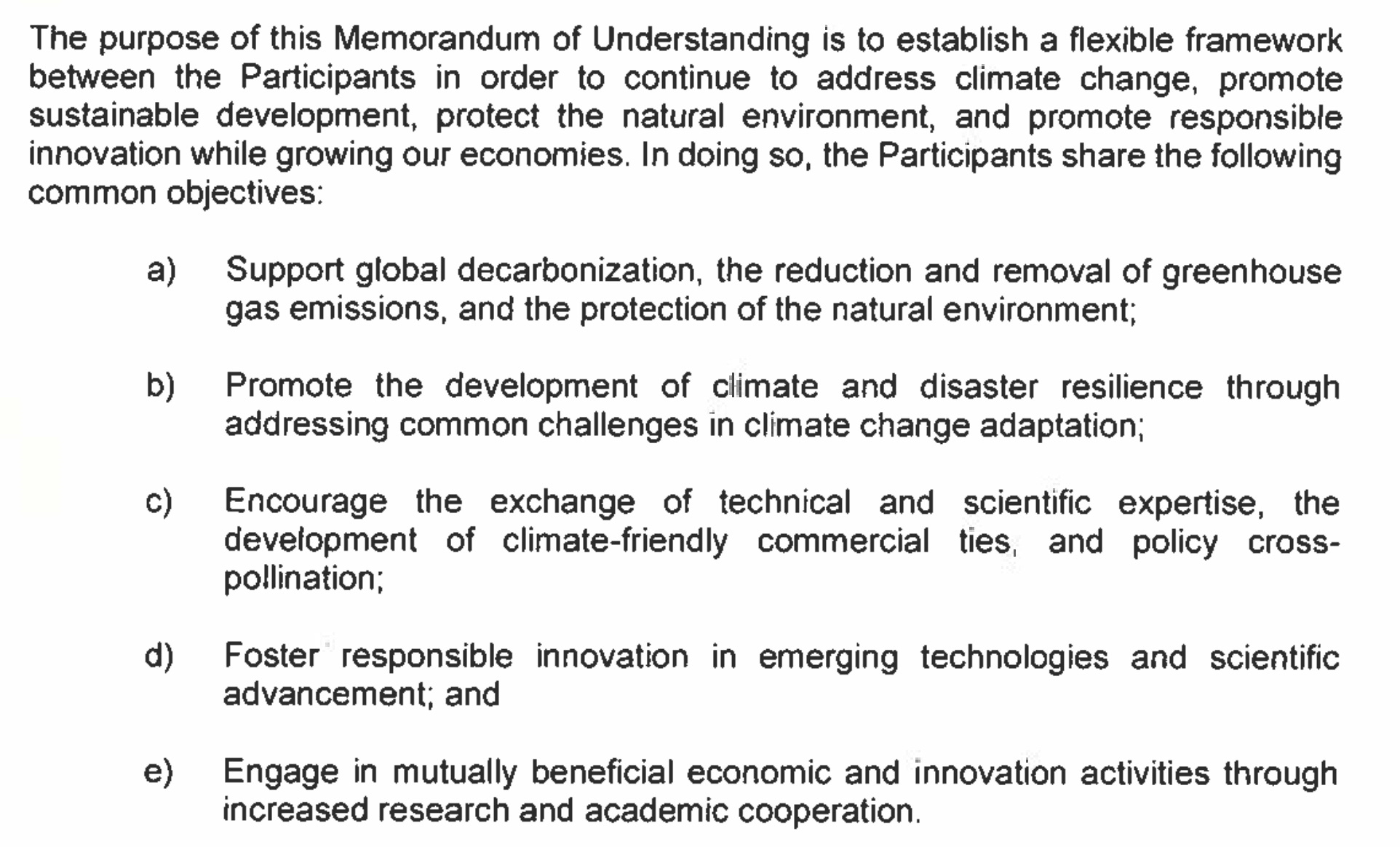
In February 2026, California Governor Gavin Newsom signed a memorandum of understanding (MOU) with the UK Energy Secretary Ed Miliband “deepening cooperation on climate.” The same day, Newsom announced that the UK’s Octopus Energy had committed $1 billion to California for “clean technologies and nature-based solutions.”
The Octopus press release, which projects a rising US investment in of $2 billion by 2030, describes the deal as “deepening its foothold” in California. Octopus will back two California carbon removal companies in “grassland restoration and reforestation” and acquire a solar and battery project in the state.
Newsom’s press release presents the UK-California agreement as part of a “global climate network” that California has built around industrial trade “[w]hile Washington retreats from global leadership.” Indeed, much of California’s climate legislation is justified as the state acting as “a global leader in addressing climate risk through state policy” while pointing to federal actors as antagonists.
The 2026 Newsom-Miliband MOU is akin to one signed 20 years earlier. In 2006, California Governor Arnold Schwarzenegger (R) and UK Prime Minister Tony Blair signed an agreement to share information and technology on the economics of climate change. Schwarzenegger said that California was well situated to create such an agreement because:
California, after all, is like a nation-state. And when we act, the world takes notice, and it has a tremendous impact, and they follow.
The agreement was politically useful to Schwarzenegger and Blair who wanted to distance themselves from the Bush administration for different reasons:
Schwarzenegger wanted to look stronger on climate in his reelection race against California Treasurer Phil Angelides, who made a name for himself by pushing the state’s pensions into the quest for climate risk disclosures.
Blair faced growing skepticism about his climate agenda as the US distanced itself from the Kyoto Protocol. California offered symbolic buy-in from a major US economy.
Blair mentioned that the agreement also committed the two to “work to educate the public on the need for aggressive action to address climate change.” At the time, Blair’s Treasury was working on the Stern Review.
The California Global Warming Solutions Act of 2006 (AB32) established a cap on GHG emissions enabling the state’s emissions trading program, and laid the groundwork for later climate risk disclosure laws:
National and international actions are necessary to fully address the issue of global warming. However, action taken by California to reduce emissions of greenhouse gases will have far-reaching effects by encouraging other states, the federal government, and other countries to act (Sec. 38501 (d)).
In the UK, Ed Miliband is closely associated with the Climate Change Act of 2008. He was the first Secretary of State for Energy and Climate Change and worked to get the bill passed. The legislation rested heavily on the Stern Review, which Ed’s brother David, then Secretary of Environment, used in drafting the bill.
The Curious Case of Octopus Energy
Octopus Energy became the UK’s largest domestic electricity supplier through a controversial government backed deal to take over customers of Bulb, which collapsed in the 2021 energy price spike, and the later 2023 acquisition of Shell Energy’s customers. Shell sold the business citing difficult conditions in European markets. Its Executive Vice-President siad:
To drive performance, discipline and simplification, we are prioritizing countries, projects, and routes to market where we can deliver the most value
Octopus sells electricity from solar and wind, and it sells gas. But its long-run aim is to sell heat pumps that move customers off gas for heating. It also provides “smart tariffs.” At the heart of Octopus was its AI management platform, Kraken, that is a one-stop shop for grid management, energy trading, and customer billing.
So, the UK’s largest energy retailer is also one of the most active advocates for an energy transition, and, as the discussion below suggests, one that is being propped up by government and a special interest.
May 2024: CalPERS, California’s public pension fund and the largest in the US, joined Australia’s pension Aware Super in a $370 million joint investment in Octopus Energy via Al Gore’s Generation Investment Management. Generation held/ holds a 13% stake in the company. The following month, Tom Steyer’s Galvanize Climate Solutions invested. Canada’s Pension Plan increased its stake to 12%. Together these helped boost Octopus to a $9 billion valuation. Media reported Octopus saying, “The investments will help to drive the company's plans to extend its Kraken energy software technology into U.S. markets.”
January 2025: At the UK–China Economic and Financial Dialogue, the two countries pledged to deepen trade links and use their financial markets for “tackling shared global issues – whether climate change, biodiversity loss, or aging populations.” China now lists green bonds on the London Stock Exchange.
Spring 2025: Octopus sponsored Tortoise Media’s Hot Air campaign, which applied an LLM trained on an old blogosphere smear campaign and guided by those that did some ugly things.
December 2025: Octopus spun out Kraken as a separate company, keeping a stake of about ~14%.
January 20th 2026: The British Business Bank, the UK government’s development bank, made its “largest ever direct investment into a private company – Octopus Energy spinoff Kraken Technologies.”
January 30th, 2026: Octopus announced a joint venture with China’s PCG Power to create Bitong Energy, to “power China’s rapidly expanding spot power markets.” The announcement came during then-Prime Minister Keir Starmer’s visit with President Xi Jinping. According to BBC reporting, the Octopus-PCG deal was among the agreements between the two heads of state, and Octopus CEO Greg Jackson was part of the UK delegation.
February 2026: The Newsom-Miliband Agreement agreement and Octopus’s $1 billion California commitment.
Writing on her blog Watt-Logic in January 2026, just after the British development bank announcement its investment in Kraken, energy analyst Kathryn Porter argued that Octopus’ financials are murky at best and indicates a company that depends on investor cash rather than its operations, even when Kraken was still in-house:
Doing a deep dive into the information published about Octopus Energy and Kraken on Companies House tells an interesting story. Despite the hype, Octopus is not a consistently profitable business nor is it generating large amounts of cash. The past year has been particularly difficult, with a significant amount of financial engineering to boost liquidity, changes in accounting principles to improve the numbers, and going concern disclosures that smack of protesting too much.
Octopus turned a profit the year it absorbed Bulb, but only briefly, reporting a £255 million loss in 2025. The Kraken sale, Porter says, was likely used to meet Octopus’s regulatory capital requirements that Octopus was otherwise unable to do.
Porter notes that on paper, Kraken is a successful global software business and in some places, “established market infrastructure” making the investment by the UK development bank curious. Moreover, she writes,
there are also unresolved governance questions around the Government stake in Kraken. Greg Jackson sits on the Cabinet Office board and on the Industrial Strategy Advisory Council, both of which provide strategic input to the Government. While this does not imply impropriety, the optics are uncomfortable: the state is taking an equity stake in a business being sold by a government adviser, whose other business appears to be struggling to meet regulatory obligations.
Public Capital, Private Interests
CalPERS explains that its investment in Octopus is part of its $100 billion Climate Action Plan, which aims to “halve the carbon intensity of CalPERS’ portfolio by 2030 and cut the risk that climate change poses to the pension fund.” CalPERS names Octopus as part of its support for climate solutions.
CalPERS places the Octopus investment within its mandate to report on climate-related risk under California’s SB 964. It does so by reference to the IFRS S2 Climate-related Disclosures issued by the International Sustainability Standards Board (ISSB), which embdedded TCFD framework.1

CalPERS makes plain that it engages in political advocacy “for climate-related policy to help generate outperformance and increase portfolio resilience.”
If Porter’s analysis is right, and I suspect at least some of it warrants serious consideration, Octopus would not look like a good investment without the climate policy and regulatory regime to cast it as one.
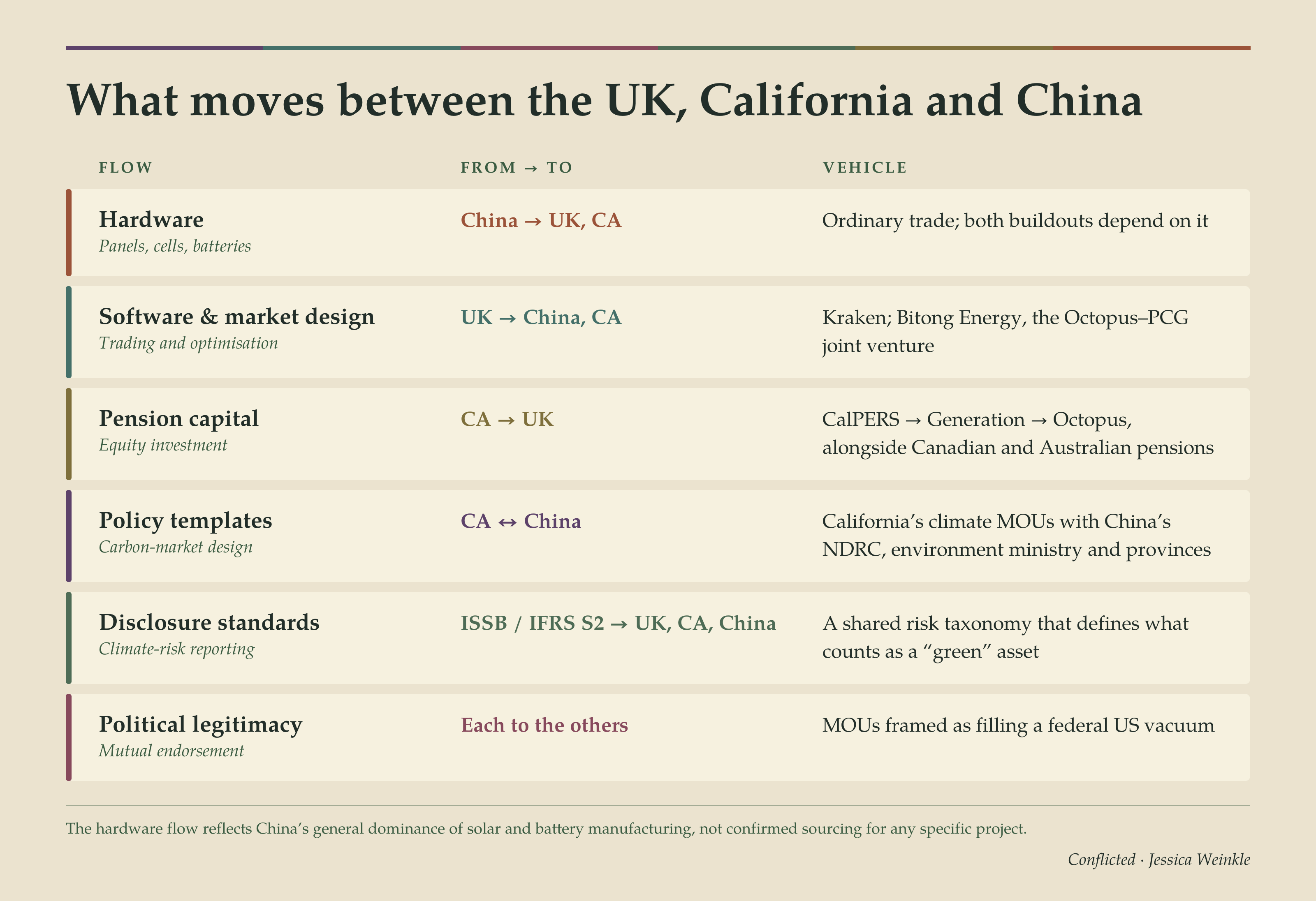
Together, the UK, California, and China form a system that the climate risk interest has spent tremendous political capital holding together:
The UK provides financial infrastructure (markets and technology) and Western legitimacy.
California provides capital, a large market, and US legitimacy that bypasses Congress.
China provides the hardware and an alternative to US global leadership on an issue- climate risk- transcends borders and works through the financial system.
For whatever the hype, 20 years on, it is abundantly clear that the UK and California have serious energy problems. The billions spent within the politically held together climate risk regime appears to circulate among a few players through common channels.
Octopus illustrates Tol and Yohe’s early critique. Working from a worldview that omits the opportunity costs of more expensive energy and the capital fixed in existing infrastructure, the UK and California doggedly pursues wind and solar without equal attention to the robustness of the energy system as a whole, leaving the two vulnerable to significant price shocks and knock-on political and economic instability.
A subsequent post follows the development and travels of the Stern Review to answer the question:
How did climate change become a job for finance ministers, central banks, and regulators?
For a primer on the difference between the two systems see CRS (2015). A more recent CRS report (2025), discusses aspects of the two systems in the context of disclosures around crypto. Contrasting one group’s dogged attempt at climate disclosures against another group’s pursuit of crypto disclosure demonstrates the value of this regulatory system in influencing the flow of investment (and also, IMO, the use of disclosures for advocacy and marketing through product placement).
Jessica is a treasure. Although sometimes I need to read and reread to follow all the dots.
Not surprised by - “UK and California doggedly pursues wind and solar without equal attention to the robustness of the energy system as a whole”. Will the elites ever learn?