
Ouroboros
The climate movement devours itself leaving behind broken institutions
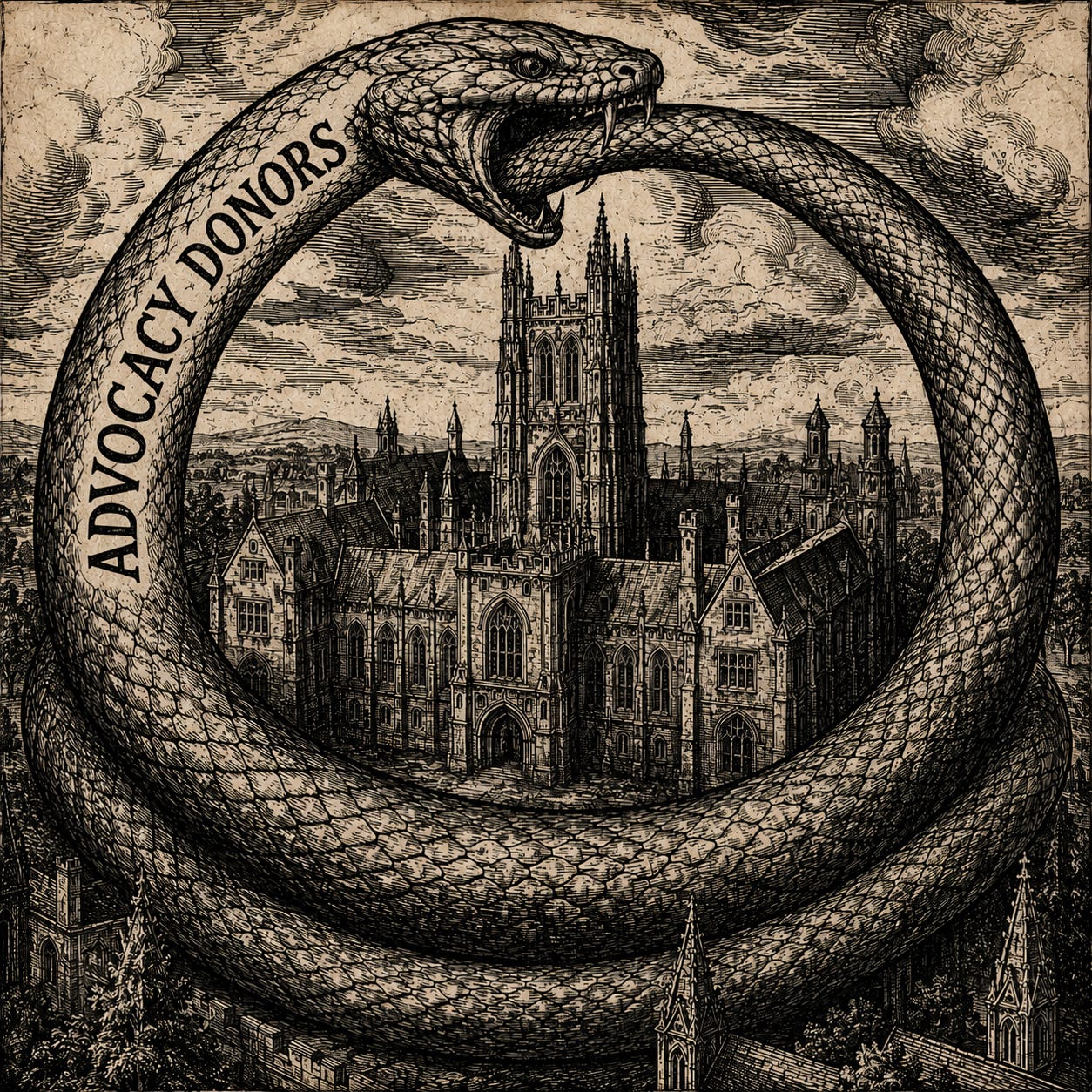
ProPublica, in partnership with Drilled Media, has a flashy exposé on BP funding of the emissions “stabilization wedges” framework developed by Stephen Pacala and Robert Socolow in 2004. The exposé blames industry money in academia for the climate movement’s folly in chasing infeasible energy policy for 20 years.
Effectively, the same sect of a movement that named anyone who did not accept the wedges paper as a “climate delayer” now argues that the wedges paper was itself a fossil fuel led conspiracy that took advantage of influence hungry academic researchers.
The issue here is not the source of funds, industry or otherwise, but the ineffective management of institutional and author conflicts of interest (COI).
Since its creation, the wedges framework had been heavily critiqued for mischaracterizing the difficulty of the decarbonization problem given existing technologies and development trends. However, the paper became foundational to the climate movement.
Those who had dared critique the wedges paper came under the wrath of advocates and their politically oriented funders who had staked the entirety of national partisan politics on the climate issue.
Ted Nordhaus recalls the drama in the note below.
So, now, the exposé finds the wedges work was, in fact, misleading and goaded an entire generation into unrealistic energy policy and dysfunctional politics:
It made solving climate change seem possible, even simple. It claimed that the world didn’t have to wait for innovation because it had the tools to start work immediately.
But that generation was mislead because advocates and their funders would have it no other way. Functional discourse and scientific debate was fiercely squashed to the point of threatening and ending researcher careers.
While cannibalizing its own movement, the exposé more seriously illustrates the failure of scientific institutions to manage donors’ influence on research and, I’d argue, the undermining of institutional neutrality.
The exposé authors explain that the wedge framing originated with BP chief executive, John Browne. Perhaps, but in the process of this documentation, the authors detail the researchers’ explicit willingness to do the bidding of whoever paid the bills:
Browne listened attentively. The straightforward framework made a complex problem seem manageable. But the “slices” terminology confused him. “They’re kind of wedges, aren’t they?” Pacala recalls him saying.
“We’re like, ‘Yeah, whatever you want,’” Pacala remembers thinking. “‘You’re paying the bills, buddy.’”
Moreover, Chris Mottershead, BP climate advisor, was intimately involved in the writing process, as the document below demonstrates. An early draft of the wedges paper showed Mottershead as an author, but he declined authorship for the final version thus resulting in ghost authorship.
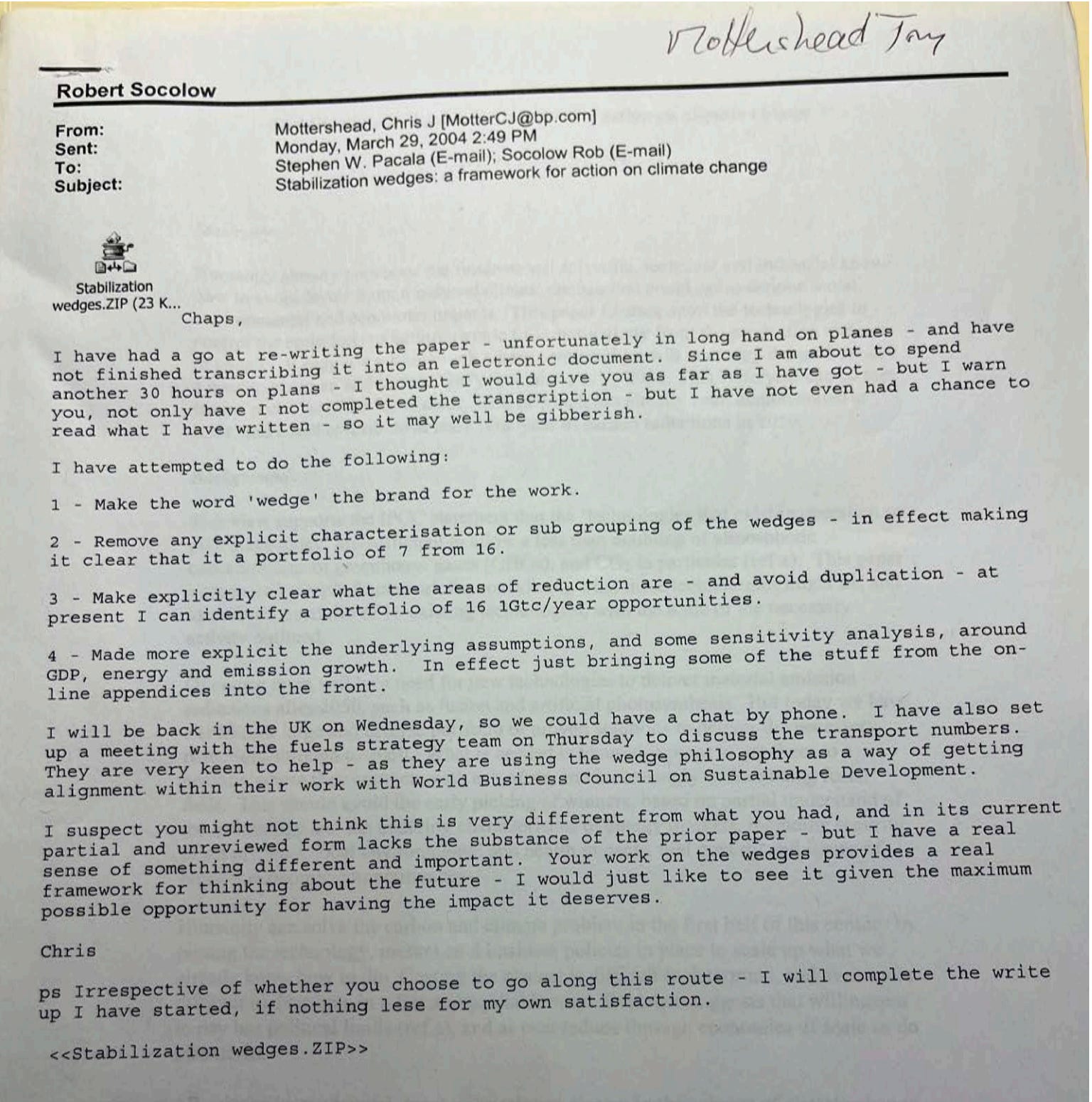
If Socolow and Pacala were willing to work in this way with BP donors, why would they — or others — not do the same for philanthropies funding the advocacy group Climate Central, of which, Pacala is a founding board member?
This is a classic tale in author and institutional conflicts of interest (COI), a point touched on in the exposé itself. It’s not a one-off, either.
A few years ago, a scholar wrote about problems of undue influence on ESG academic research from financial industry donors. I’ve written extensively on this Substack about issues of non-disclosure and capture.
Drilled media is itself designed specifically around climate litigation. The exposé authors cite Naomi Oreskes as commenting on the COI problem
“It’s the whole subconscious bias problem,” said Harvard historian of science and corporate influence expert Naomi Oreskes. If “continued funding relies on having this good relationship and having this alignment, you are going to be influenced by it.”
Yes, and this fairly well describes all of the weather and climate research designed for litigation, insurance and finance, regulation, and politics.
Michael Oppenheimer, was also quoted by the exposé writers in explaining that
Princeton doesn’t train researchers on how to navigate the influence that might come from close interactions with sponsors.
How very interesting coming from an illustrious researcher that has, for decades, moved seamlessly between advocacy (also including Climate Central) and science advisory reporting.
Apparently, Oppenheimer’s comment created a stand-off between researchers and Princeton for who is responsible for maintaining integrity in science:
A spokesperson for Princeton told ProPublica and Drilled that the university provides “extensive guidance and information” to faculty and researchers about working with industry.
Which passes the buck to professional norms maintained by discipline organizations and academies, whose leaders refuse to acknowledge a problem.
The exposé demonstrates, at least outside of medicine, how poorly scientific institutions manage conflicts of interest and police research integrity among their own.
I’ll follow this general theme in subsequent posts.
“It’s the whole subconscious bias problem,” said Harvard historian of science and corporate influence expert Naomi Oreskes. If “continued funding relies on having this good relationship and having this alignment, you are going to be influenced by it.”
It's amazing how "experts" at identifying the influence of money on climate have this massive blind spot about funding that supports their preferred narrative. It's almost as if they don't really care about the influence of money, they only care about their preferred narrative.
It may be a false memory, but the name Socolow rings some kind of bell in my mind regarding corruption and/or flat our lying in the anti-nuclear context.